
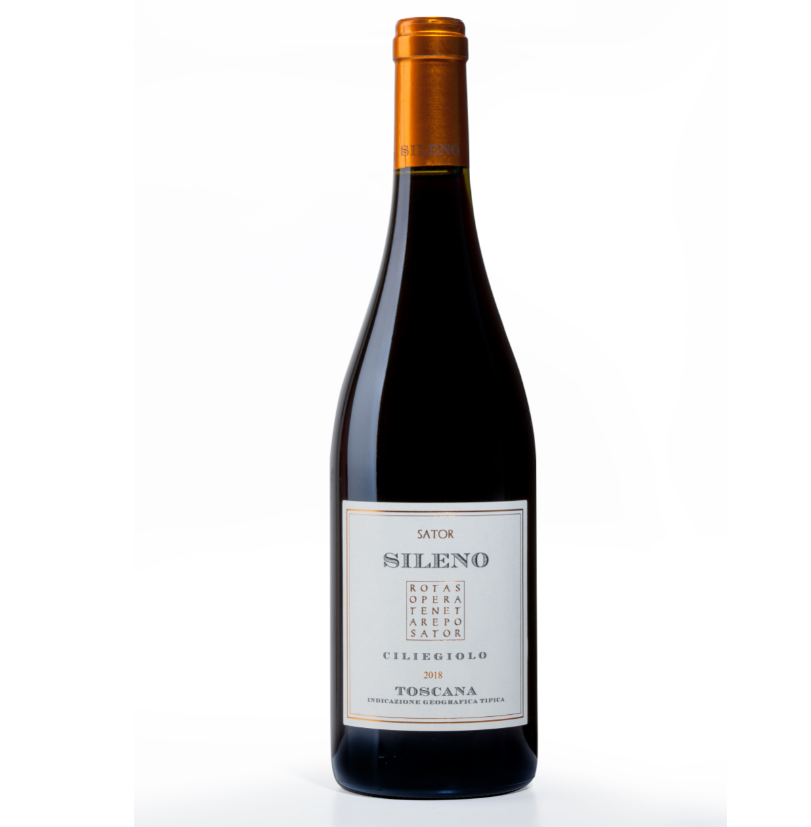
This is a pre-arrival offering that is expected November/December 2026. Please order these Moscardini wines separately from the wines of other producers. The minimum order is 3 bottles - mix or match.
Our tasting impressions
The current release of this wine, 2021, is lovely. But this being VDLT, when Gianni said he still had a stash of 2018, we said, "yes, please!"
The wine has gorgeous, vibrant cherry fruit, and at least for now, some oak flavors. A touch of mushroom-y umami offers a stunning counterpoint. The tannins are so fine that they're barely perceptible. But they do provide noticeable structure. A great drink now but there's no rush given the structure, acidity and vibrant fruit.
Don't miss this beautiful and impressive Tuscan rosso that's as comfortable on the dinner table with a steak as it is with red sauce pasta. In fact, Ciliegiolo might just be better with the latter than Sangiovese, due to its higher natural acidity.
About this wine
Ciliegiolo planted in magmatic-volcanic, clay and limestone soil. The grapes are harvested manually and vinified separately, based on soil origin. Fermentation is with indigenous yeasts in stainless steel tanks at a controlled temperature. About 10% of the whole bunch is introduced in order to to enhance the aromas and freshness. Maceration for 10 days.
The aging vessel and duration for this wine vary according to climatic conditions and soil. In 2018, Gianni used 500L oak barrels for one year. After bottling, it stayed in the cellar for 18 months before release.
About the grape
Ciliegiolo (little cherry in Italian) is having a moment. Genetically related to Sangiovese, it is Tuscan in origin but can also be found in Liguria, Umbria, Lazio and Puglia. Wines from the variety tend to be medium bodied, structured, fruity and smoothly tannic. It's a hugely underrated grape.
Gianni's perspective on the vintage
2018 Winter temperatures were typical, with only a short period below zero. Rain was heavy in January and February. Buds started sprouting at the beginning of April. Spring was a mix of extreme heat , humidity and rain, which led to flowering at the beginning of June. More rain came at the end of July, which helped cool the hot summer and allowed the grapes to add ripeness and sugar. The fall brought ideal conditions.
The harvest started at the end of August for Merlot and Ciliegiolo, followed by the Vermentino and the Fiano grapes, ending with the Sangiovese grapes at the beginning of October.
Gianni Moscardini's azienda in the village of Pomaia is in the northern Tuscan Maremma. This is the west coast, near Pisa. The Moscardini family has owned this land for 2 centuries but Gianni was the first to plant vines in its varied soils in 2008.
Production is growing and will soon reach 100,000 bottles annually from the 13.5ha of vines. The southwest-facing vineyards are trained in either the Guyot or Cordone Speronato system. All of the varieties are planted in at least 2 plots - each with a different soil composition - including some volcanic (YEAH!).
Gianni is an agronimist and his wife Meri is a plant biologist at the National Council of Research in Pisa. Together, they have deeply studied the soils and terroir of their land to determine what varieties will perfom best. Their credo is to produce wines that fit seamlessly with the land, which is why they vinify the grapes from each plot separately prior to blending.
VDLT is the only U.S. source for current offerings Gianni's wonderful, singular wines.
